Human Development and Family Studies
 Beth Fauth's research focuses on the development, evaluation, and dissemination of digital mental health interventions for caregivers of people with dementia, as well as for people with a recent dementia diagnosis. Interventions are based in Acceptance & Commitment Therapy (ACT), in collaboration with multiple faculty members in the college. She and her research team at the Alzheimer's Disease and Dementia Research Center also utilize functional near-infrared spectroscopy (fNIRS) to examine a motor-based cognitive test that may be effective as a low-cost screener for mild cognitive impairment. Beth Fauth's research focuses on the development, evaluation, and dissemination of digital mental health interventions for caregivers of people with dementia, as well as for people with a recent dementia diagnosis. Interventions are based in Acceptance & Commitment Therapy (ACT), in collaboration with multiple faculty members in the college. She and her research team at the Alzheimer's Disease and Dementia Research Center also utilize functional near-infrared spectroscopy (fNIRS) to examine a motor-based cognitive test that may be effective as a low-cost screener for mild cognitive impairment.
Yin Liu’s research focuses on empowering families to manage dementia and chronic health conditions by understanding the daily drivers of resilience and well-being. Using advanced tools—including wearable sensors, biological stress markers, and daily diary tracking—I capture the real-time unfolding of family interactions and support patterns. This data-driven approach moves beyond static snapshots of health to reveal how families navigate challenges day-to-day, providing the evidence base needed to design effective community-based support systems that enhance quality of life for both patients and caregivers.
Robert Stawski: Research focuses on understanding the social, psychological, and biological underpinnings of mental, physical, and cognitive health in the context of adult development and aging. A central component of this program is the development, optimization, and application intervention- and change-sensitive assessment of health, wellbeing, and cognition via intensive repeated measures (e.g., daily diary, ecological momentary assessment), remote and ambulatory assessment, and measurement burst approaches, for studying people in their daily life contexts.
|
Instructional Technology and Learning Sciences

David Feldon’s area of research is the development of expertise. His research focuses on understanding the principles and practices of training and assessment optimized for adult learners in Science, Technology, Engineering, Mathematics and Medical (STEMM) fields. In addition to studies of research skill trajectories in biomedical graduate training, he also conducts and studies cognitive task analysis as a foundation for simulation-based and conventional training.
Taehyun Kim is currently leading a project focused on developing VR simulations and AI agents for nursing education. The goal is to create immersive, scenario-based training modules where nursing students can practice clinical reasoning, communication, and procedural skills within a safe, controlled environment. The AI agent is designed to respond to student actions, provide guidance, and simulate patient behavior using both verbal interaction and gesture-based cues.
Lu Lawrence’s research is focused on co-designing learning environments with communities. Her projects at the intersection of health and technology are in the context of sexual health education. In one project, she collaborates with healthcare experts and students to co-create resources to identify and combat AI-mediated misinformation about sexual health.
Breanne Litts works in collaboration with Melissa Tehee (Psychology) to conduct research that leverages technology to center culture in educational and healthcare contexts. They examine how technology can support youth, families, communities, and professionals in classrooms, Tribal communities, healthcare settings, and beyond. In practice, they design interactive trainings to build cultural competence among healthcare professionals, develop technology-integrated curricula with educators to foster cultural understanding, and implement methodologies that promote reciprocity and wellbeing in technology-based research and design.
|
Kinesiology and Health Science

Eadric Bressel: Research examines biomechanical adaptations to therapeutic exercise in healthy and special populations. Dr. Bressel has a specific interest in spine stabilization exercises, determinants of balance, and rehabilitation of chronic conditions such as osteoarthritis using an aquatic environment.
Kim Clevenger: Research focuses on identifying valid, reliable, and responsive measures of physical activity and its context, such as location, especially in children. Dr. Clevenger mostly use accelerometry but also direct and video observation, global positioning systems, bluetooth, etc.
Chris Dakin, director of the Neuromechanics Lab, investigates the basic science underlying how sensory input shapes movement and designs interventions that modulate or augment this input to reduce disability, address sensory-related disorders, and enhance human performance.
Talin Louder: Research examines wearable technologies, the sensorimotor and neuromuscular determinants of agile movement, and the therapeutic potential of aquatic environments in exercise and rehabilitation. Specifically, Dr. Louder investigates how technology-enabled assessments and interventions can enhance motor performance, optimize neuromuscular control, and improve recovery and accessibility across diverse populations.
Breanna Studenka: Studies how humans plan, coordinate, and adapt their movements. The work focuses on developing sensitive behavioral measures to understand motor planning flexibility across development, expertise, and neurological differences.
Dale Wagner: Conducts research using state-of-the-art lab equipment (DXA, load cells, plethysmography) and is currently in conversation with an app company that creates a 3D avatar-like image of a person from a few smartphone photos and then converts that into body composition estimations.
|
Psychology

Michael Levin: Research focuses on the development, evaluation, and dissemination of digital mental health interventions based in Acceptance & Commitment Therapy (ACT). He collaborates with experts in applying digital ACT to a variety of targeted populations, including specific psychiatric disorders and chronic health conditions, most notably with Dr. Michael Twohig in studying digital ACT to obsessive compulsive and related disorders.
Melissa Tehee works in collaboration with Breanne Litts (ITLS) to conduct research that leverages technology to center culture in educational and healthcare contexts. They examine how technology can support youth, families, communities, and professionals in classrooms, Tribal communities, healthcare settings, and beyond. In practice, they design interactive trainings to build cultural competence among healthcare professionals, develop technology-integrated curricula with educators to foster cultural understanding, and implement methodologies that promote reciprocity and wellbeing in technology-based research and design.
Michael P. Twohig: Research focuses on the development, evaluation, and dissemination of Acceptance and Commitment Therapy (ACT), particularly for obsessive-compulsive and related disorders. Dr. Twohig collaborates with Dr. Levin to create web-based ACT interventions targeting conditions such as trichotillomania, skin picking, misophonia, and obsessive-compulsive disorder. Together, they have also developed online ACT programs addressing broader concerns like burnout and healthcare management. Dr. Twohig is actively involved in advancing the digital dissemination of ACT in his professional practice and academic research.
|
Special Education and Rehabilitation
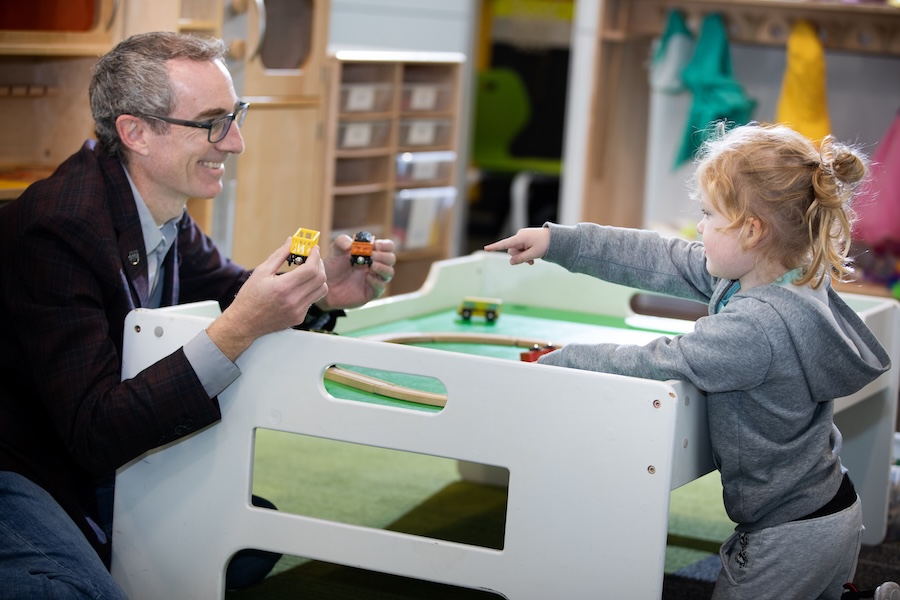
Naima Bhana-Lopez’s work focuses on assistive technology, particularly augmentative and alternative communication systems. Her research involves developing caregiver-implemented interventions that use augmentative and alternative communication systems to promote the development of social-communication skills in young children with developmental disabilities.
Casey Clay uses continually improving technology related to visual presentation capabilities (AI videos, virtual reality, augmented reality) for training caregivers (e.g., parents, clinicians, teachers) on behavioral assessment and intervention for children with disabilities. The technologies allow for more efficient and effective training that give the trainee more opportunities to interact with the training for skill development.
Tom Higbeeinvestigates technology-based training approaches to support both professionals and caregivers who interact with young children with autism and related disabilities. This includes telehealth-based coaching and interactive computerized training methods.
|
Speech and Hearing Sciences

Stephanie Borrie develops technology-enabled, human-centered approaches to understand and improve real-world communication for people with communication disorders. By integrating advanced speech signal processing, engineering-informed analytics, computational modeling, and theories of human interaction, her work identifies and targets the interaction behaviors that most directly support meaningful conversation and everyday quality of life.
Annalise Fletcher develops acoustic analysis techniques to capture subtle changes in disordered speech and objectively distinguish core features of neurological speech disorders, including reduced voice quality, hypernasality, and articulatory imprecision. The goal is to align these signal-level metrics more closely with listener perceptions, producing clinically meaningful indices of speech impairment.
Sandi Gillam’s research focuses on developing and implementing evidence-based language and literacy interventions for children with Developmental Language Disorder (DLD) and related communication difficulties. She led the development of Supporting Knowledge in Language and Literacy (SKILL), a multicomponent narrative intervention funded through multiple IES projects, and has advanced tools for automating language sample analysis and progress monitoring. Across projects, my goal is to translate research into practical solutions that enable clinicians to deliver effective, evidence-based interventions efficiently, even under high workload and time constraints.
Aryn Kamerer's area of research is auditory physiology. Her research focuses on understanding pathophysiologies that underlie hearing concerns and developing tests to identify, differentiate, and characterize those pathologies. She is currently working on a diagnostic tool that uses easy-to-collect electrophysiological responses to auditory stimuli in conjunction with AI to identify several auditory neural pathologies that cannot currently be identified or measured in the clinic.
Karen Muñoz’s research focuses on person centered care in audiology and factors that influence patient/caregiver engagement in hearing treatment and developing interventions that support health behavior change for parents of young children who use amplification. She is currently developing a hearing aid management education and support smartphone app in collaboration with an interdisciplinary team that is funded by an industry partner. The app incorporates AI supported goal setting to guide parents in adjusting their routines and challenges to improve hearing aid adherence.
|
