
Inaugural USU Brain Health Fair to Bring Together Experts and Northern Utah Community on June 13
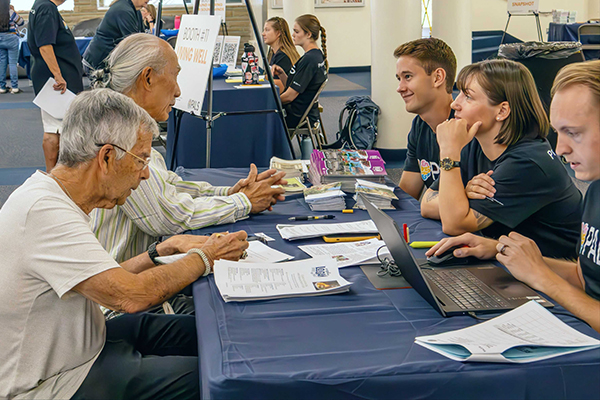
Community members consult with USU experts about aspects of healthy aging.
The Emma Eccles Jones College of Education Human Services at USU is hosting its first annual USU Brain Health Fair. The free event is open to the public and will be held in the Sorenson Legacy Foundation Center for Clinical Excellence on the Logan campus on Saturday, June 13 from 10 a.m. to 4 p.m.
“The inaugural Brain Health Fair is a landmark event for the Emma Eccles Jones College of Education and Human Services,” said Shawn Whiteman, Ph.D., executive associate dean of the college. “Showcasing cutting-edge research at the intersection of healthy aging, cognitive and physical development, and behavioral care, this event celebrates the innovative health-related work happening across our college. Paired with the extensive clinical services offered through the Sorenson Legacy Foundation Center for Clinical Excellence, the fair highlights our strong commitment to applied research and learning as well as meaningful community impact.”
The USU Brain Health Fair aims to provide resources for anyone wanting to know about healthy aging, as well for people who are experiencing memory loss and those who care for them. Attendees can expect to learn about modifiable lifestyle behaviors to help combat cognitive decline, discover strategies to reduce their risk of dementia, and learn actionable steps to promote healthy aging and improve overall brain health.
The event is a collaboration between the Emma Eccles Jones College of Education and Human Services, Intermountain Healthcare, USU’s Alzheimer’s Disease & Dementia Research Center (ADRC), and the Sorenson Legacy Foundation Center for Clinical Excellence. It will feature community partners and USU experts in psychology, aging, nursing, neuroscience, balance, hearing, and more.
“Many people are aware of how to take care of their heart and their muscles as they age, but fewer people have knowledge and resources for maintaining their brain health,” said Beth Fauth, executive director of the ADRC. “We want to offer some of that education for our community through this event. We also want to help people understand where to go when they suspect memory changes might be occurring, or even where to go for support after a diagnosis. This event will showcase the research and services we have available at USU and with our community partners. With healthy food, photography, and a variety of activities, we are also hoping it will be a fun event.”
Attendees will benefit from cooking demonstrations and sample diets focused on food for brain health; receive free hearing screenings from local audiologists; view the human side of cognitive health at the Faces of Dementia photo exhibit; participate in tai chi, chair yoga, and laughter yoga sessions; and visit a dedicated space just for family caregivers to find support, local resources, and professional guidance for concerns they may have now or in the future.
Experts from Logan Regional Hospital, an Intermountain Healthcare provider will be on hand to share information on overall heart health, strokes, stopping the bleed, physical therapy, and gerontology services. Other community resources include the Institute for Disability Research, Policy & Practice; USU Extension; Alzheimer’s Association; Bear River Association on Aging; Cache Senior Center; and the Utah Assistive Technology Program.
A highlight of the event will be a panel discussion led by Beth Fauth, Ph.D., and Landon Watts, DO, physician of geriatric medicine and internal medicine at Intermountain Healthcare. Their discussion is entitled “Memory Matters: How to Spot the Signs and Where to Find Support,” and will include a general overview of cognitive decline, early detection, cognitive tests, post-diagnosis support, caregiving resources, and community support. Two panels will be presented at 11 a.m. and 2 p.m. and each will conclude with a Q&A segment.
Both panelists are leading experts in aging and cognition. Passionate about helping his patients live healthy lives, Watts supports older adults in northern Utah and southeastern Idaho by treating frailty, gait disorders, falls, polypharmacy, malnutrition, and more. Fauth, a professor in the Department of Human Development and Family Studies, researches stress relative to dementia caregiving and ways to support quality of life for persons living with dementia. She also assesses caregiver interventions.
Another major component of the Brain Health Fair is voluntary participation in an ongoing research study—Prevent Alzheimer’s For Life Study (PALS)—conducted by an extensive team of USU researchers, with JoAnn Tschanz, Ph.D., clinical neuropsychologist and professor in the Department of Psychology at USU, leading the study. The second floor of the Sorenson Center will be dedicated to PALS.
The study is examining the impact of modifiable lifestyle factors on Alzheimer’s Disease. Participating experts will provide research-based strategies to prevent cognitive decline, encourage healthy lifestyles, and enhance overall well-being. Eleven lifestyle factors—the backbone of the data being collected—will be highlighted at the fair. These lifestyle factors are diet, strength and physical activity, balance, stress and wellbeing, sleep, chronic pain, aging, social activity, cognition, hearing, and overall health.
Fair attendees may visit booths that focus on each of these factors and speak directly with researchers. All informational booths and study-related activities on the second floor of the Sorenson Center will be available to fair attendees, even if they are not enrolled in the study.
Please note that entrance to the Brain Health Fair and on-campus parking at the Sorenson Center are free of charge. Visit the USU Brain Health Fair website to access driving directions, a schedule of events, and more. Visit the PALS website to learn how to enroll in the study prior to the USU Brain Health Fair.