
What is the MIND diet?
 According to studies described on the Alzheimer’s Association website, the MIND diet combines the Mediterranean diet with the DASH diet (Dietary Approaches to Stop Hypertension) to reap the combined cognitive and physical health benefits of both diets. The MIND diet targets neurological conditions and cognitive decline and may work as a research-backed protective intervention against dementia.
Does the MIND Diet decrease the risk for Alzheimer’s disease?
- A review published in Advances in Nutrition found that a strict adherence to the MIND diet resulted in a 53 percent reduced risk for Alzheimer’s disease, and even loosely following the diet resulted in a 35 percent reduction in risk.
- As discussed on the Harvard School of Public Health website, the original study from the Rush Memory and Aging Project found that older adult participants who followed the MIND diet had better memory scores, larger brain volume, and less cognitive decline.
- As reported by CNN Health, MIND diet foods are abundant in vitamins, nutrients, and antioxidants that reduce inflammation and improve cellular metabolism. Following the MIND diet also helps manage other conditions — such as obesity and heart disease — that can worsen the effects of Alzheimer’s disease.
What to Eat and What to Avoid
The MIND diet includes whole grains, leafy greens, nuts, beans, poultry, fish, and berries. The MIND diet also aims to limit foods high in trans and saturated fats such as pastries and sweets, red meats, butter and margarine, cheese, and fried foods.
Even moderately following the MIND diet can help reduce your risk for Alzheimer’s disease. Mind diet guidelines to follow...
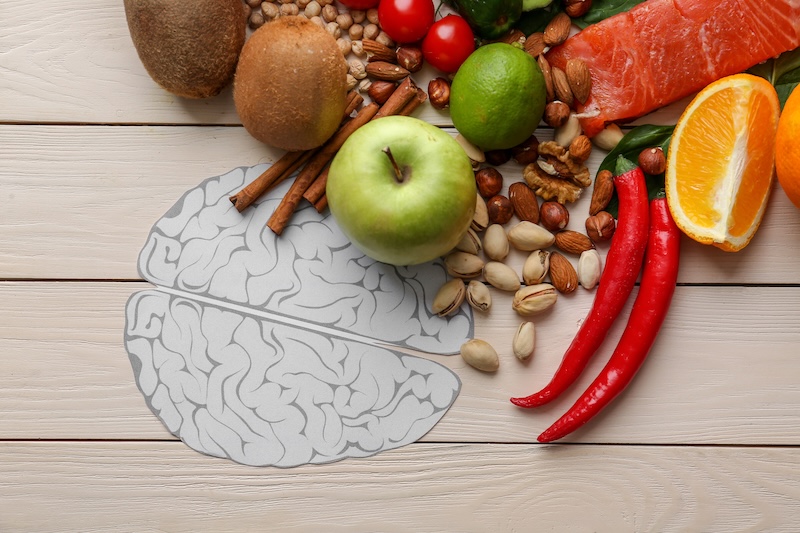
- 6+ servings/week of leafy greens (kale, spinach, romaine lettuce, collard greens)
- 1+ servings/day non-starchy vegetables (mushrooms, asparagus, cauliflower)
- 2+ servings/week berries (blueberries, strawberries, raspberries
- 5+ servings/week varied nuts (almonds, pistachios, cashews)
- 1+ servings/week fatty fish (salmon, tuna, tilapia, cod, halibut)
- 2+ servings/week poultry, not fried (chicken, turkey)
- 4+ servings/week beans (lentils, black beans, chickpeas, soybeans)

- Less than 5 servings/week of pastries
- Less than 4 servings/week of red meats (beef, pork and lamb)
- Less than 1 serving/week of fried foods
Reference: Diet Review: MIND Diet. (2022, July 15). The Nutrition Source. https://nutritionsource.hsph.harvard.edu/healthy-weight/diet-reviews/mind-diet/
Sources
- Diet Review: MIND Diet. (2022, July 15). The Nutrition Source.
- Food for Thought. (2019). Alzheimer’s Disease and Dementia.
- LaMotte, S. (2023, March 8). Mediterranean and MIND diets reduced signs of Alzheimer’s in brain tissue, study finds. CNN.
- Soest, van, Beers, S., van, & C.P.G.M, L. (2024). The MIND diet for the ageing brain: a systematic review. Advances in Nutrition, 15(3), 100184–100184.