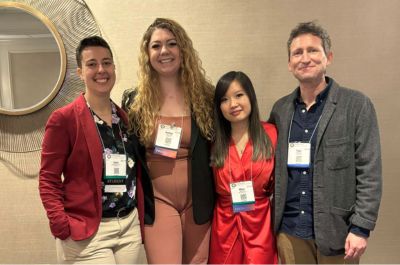
The School Psychology Ph.D. specialization at USU prepares students to become professional psychologists with the skills to work in research institutions and practice in a range of settings including schools, clinics, hospitals, and other community agencies.
School psychologists play a crucial role in promoting the mental health and educational success of youth, their caregivers, and their communities. Our program emphasizes the development of scientific problem-solving skills and comprehensive competencies in assessment, intervention, consultation, and collaborative care. We prioritize science-based, culturally responsive, ethically informed, and legally compliant practices within educational and healthcare environments.
The School Psychology specialization features accomplished faculty with expertise in the areas of school mental health, self-regulated learning, and suicide prevention. Program faculty value mentoring students and are focused on preparing the next generation of researchers, trainers, and leaders in the field of school psychology.
APA Accredited Program
The School Psychology PhD Program was established in the 2018–19 academic year. The Program has been granted initial accreditation by the American Psychological Association through 2026.
Internship Placement
Students in this program are regularly matched with APPIC internships with a 100% success rate. Most students have also been matched with APA-accredited internships.
Community Building
Enrollment in the USU PhD program requires full-time, in-residence participation by all students. Students entering the program typically spend 4-5 years on campus, engaging in didactic, research, and clinical training activities.
Program Benefits
For approved programs of study, your tuition is fully covered and you will be awarded an assistantship with a monthly stipend. Assistantships include research, clinical, and teaching experiences, allowing you to expand your academic skillset.
The School Psychology PhD specialization is not accepting applications for Fall 2026.
Submit the following to the School of Graduate Studies:
Application
CV
Three Letters of Recommendation
Unofficial transcripts from all previous schools. Official transcripts will be required if accepted into the program
Please provide a personal statement (500–1000 words) that addresses the following:
What personal history or experiences have motivated you to pursue a PhD in psychology?
Given there are many fields in psychology, why are you specifically seeking a PhD in school psychology?
Why would you like to join our school psychology PhD program here at USU? Specifically, which faculty/labs are you interested in working with and why?
If you were to join our PhD program, what contributions would you bring/make toward improving or expanding the work we do in the field of school psychology?
What are your career goals and ambitions related to the field of school psychology?
Admission Criteria:
GPA for the last 60 credits taken of 3.0 or higher
Fit with a current faculty member affiliated with the specialization
Substantial background in psychology
Applications are due December 1st.
The School Psychology PhD specialization is not accepting applications for Fall 2026.
Just before, during, and after learning or performing askill, individuals have the opportunity to engage several processes and beliefs that can facilitate more efficient skill development and/or performance. For example, setting goals, planning, using a variety of strategies,self-monitoring, and reflecting after performance can all help an individual learn and perform better. In addition, these processes influence and are influenced by motivational beliefs. Collectively, these processes are part of a system referred to as self-regulated learning (SRL).This research labexamines the development of innovative measurement tools to examine these processes, the development of interventions to foster SRL, and how educators and school psychologists can support the development of SRL. We have completed research within several domains such as mathematical problem solving, test taking, creativity, and reading.
The Suicidology Lab | Erik Reinbergs
The Suicidology Lab at USU researches suicide and its prevention—including aspects of assessment, treatment, public health, and more. We have a particular focus on youth and young adult populations. Suicidology is a dynamic, interdisciplinary field that overlaps with many areas of psychology, psychiatry, social work, public health, sociology, legal studies, philosophy, applied statistics, and more. It also touches many related areas of study within health service psychology, including non-suicidal self-injury, mood disorders, behavior therapies, borderline personality disorder, and crisis states. We believe the overarching goal of this work is to help people build lives worth living.
School Mental Health Lab | Tyler Renshaw
The big idea driving our work in theSchool Mental Health Labis that schools should be community hubs for mental health services; not just for kids, but also for educators and parents and families. We believe schools should offer both prevention and treatment, and should balance reducing suffering with improving wellbeing. Most importantly, we believe school-based services are integral to promoting mental health equity. The lab has three main lines of research:
Validating brief rating scales for assessing key mental health variables, including suffering and wellbeing indicators.
Evaluating the effects of simple mindfulness interventions with students, teachers, and parents.
Systematically reviewing the effects of interventions that involve mindfulness (e.g., CBT, ACT, DBT, & SEL) with youth and caregivers.
Student Spotlight
Mary Phan - School Psychology
Mary Phan is a doctoral student in the school psychology program working under Dr. Tyler Renshaw. Her research interests are focused on implementing mindfulness-based interventions to underserved youth in public schools. Mary was born and raised in Trenton, New Jersey but lived near the Philadelphia area as she earned her bachelor's degree in psychology at Temple University.
Mary shares how she decided USU was the right place for her and some of her future goals in the field of psychology.
We are thrilled to introduce three exceptional additions to our faculty at Utah State University. Each brings a wealth of experience and passion to our community, and we’re excited to see the impact they’ll make in the psychology department.
a combined total of nine doctoral students from the Combined Clinical/Counseling and School Psychology specializations matched with internships locations this spring marking another year of 100% match rate for internship placement in these programs!
Six graduate students, along with two faculty members from the Utah State University (USU) psychology department’s school psychology program attended and presented at the 2024 National Association of School Psychologists (NASP) annual convention.
Disclosure of Educational Requirements for Licensure by State
The PhD specialization adheres to APA accreditation standards and prepares students for entry into the profession of health service psychology with an emphasis in school psychology. The EdS Program adheres to NASP training standards and prepares students for entry into the profession of school psychology. Given the varied and changing requirements across jurisdictions, we have not determined and cannot assure that graduates will meet all requirements for licensure in all states or territories. Students are encouraged to become familiar with relevant state licensing laws and discuss their curricular plan with their major professor and specialization director.
This specialization meets requirements for licensure as a psychologist in Utah.
USU has not determined if the specialization meets requirements in: AK, AL, AR, AS, AZ, CA, CO, CT, DC, DE, FL, GA, GU, HI, IA, ID, IL, IN, KS, KY, LA, MA, MD, ME, MI, MN, MO, MP, MS, MT, NC, ND, NE, NH, NJ, NM, NV, NY, OH, OK, OR, PA, PR, RI, SC, SD, TN, TX, UM, VA, VI, VT, WA, WI, WV, WY.
Accreditation
The School Psychology PhD Program was established in the 2018–19 academic year. The Program has been granted initial accreditation by the American Psychological Association for the period of May 11, 2021–May 11, 2026 (5 years). See student admissions, outcomes, and other data for this specialization. Answers to questions regarding accreditation and related standards are available through APA:
Office of Program Consultation and Accreditation American Psychological Association 750 First Street NE Washington, DC 20002-442 202-336-5979 Visit APA’s website