Understanding the Role of Gender in Engaging the Interest of Girls in Computer Science
In order to contribute to the evidentiary knowledge base about strategies and models that enhance girls' interest in and self-efficacy to pursue Computer Science (CS), we studied the effects of single-gender programming camps and gender-aligned role models.
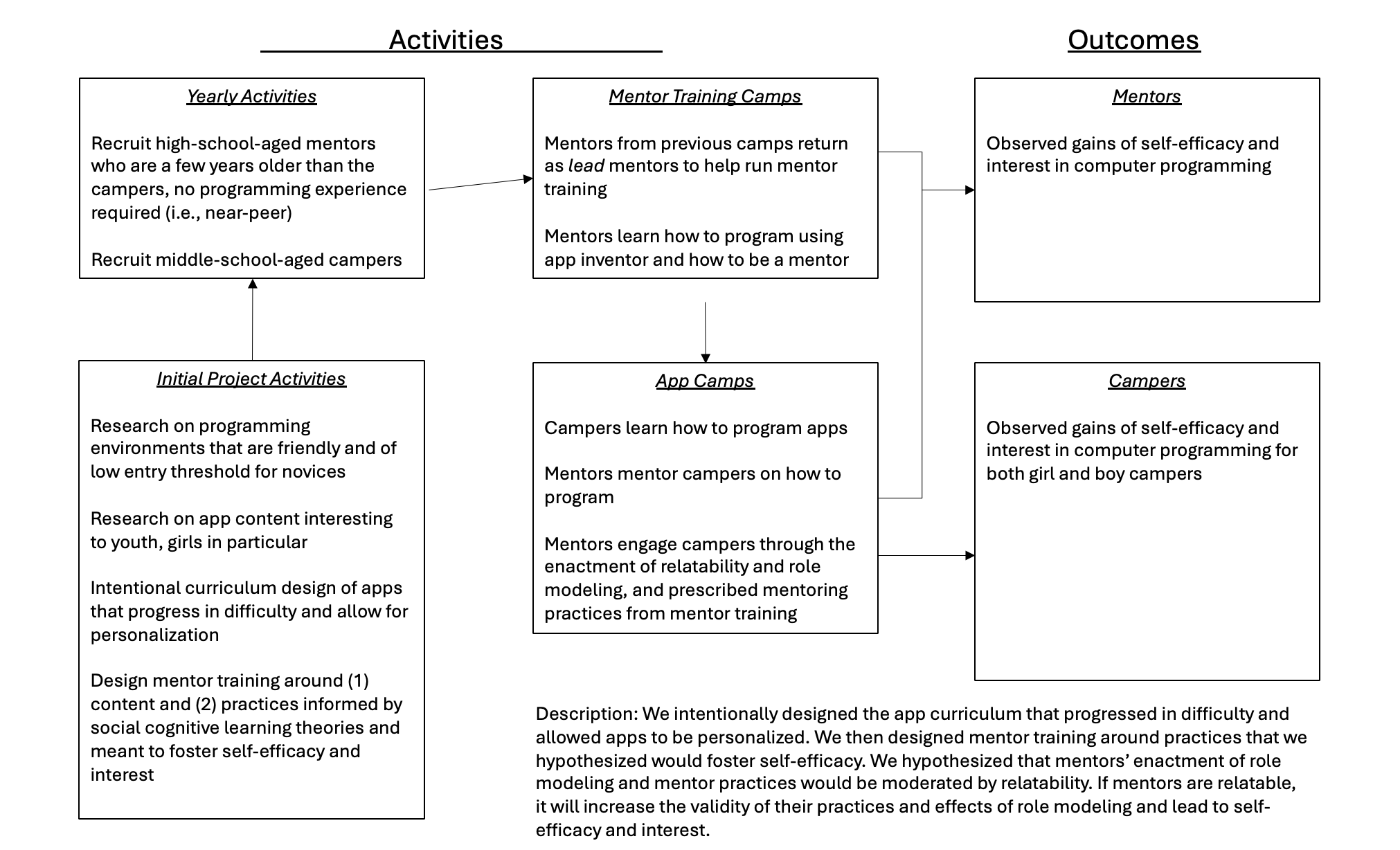
We developed a near-peer mentoring model in which we trained high school youth with little or no programming experience how to program apps and be mentors. They then helped us run summer camps and served as mentors for middle school youth. Participants included 13 lead mentors, 68 mentors, and 359 campers.
We tested four conditions: (1) female campers + female mentors; (2) mixed gender campers + female mentors; (3) female campers + mixed gender mentors; (4) mixed gender campers + mixed gender mentors.
Using a 2x2 quasi-experimental design, we tested the main effects and interactions between female-only and balanced gender CS camps for middle school students and female-only and mixed-gender role models (with the majority being female) on youth's self-efficacy and interest.
Key Findings include:
All campers, regardless of gender, reported a significant increase in self-efficacy in programming and interest in programming after attending the camp. We did not find any significant differences in change of self-efficacy and interest based on camper gender.
Working with a mentor of the same gender did not have a significant influence on changes in self-efficacy in programming or interest in programming.
We found that relatability of a role model, the sense of perceived similarity and an affective connection between self and the role model, was more important than the gender of the role model in influencing youth's self-efficacy and interest.
A role model is relatable if an individual perceives them as related to their goals, or perceives them as similar, or if their success is perceived as attainable, or if they are emotionally available to develop a personal connection to the role aspirants.
We found that mentor relatability significantly predicted campers' change in self-efficacy in programming and role modeling and relatability both predicted campers' change in interest in programming.
Key Findings Specific to Girls:
Mentor gender composition (all female mentors vs mixed gender mentors) did not influence how camper gender composition (all girls vs mixed gender campers) affected girls' self-efficacy and interest, and vice versa. This result suggests that regardless of mentor gender composition, presence of boys in camps did not affect girls' self-efficacy or interest.
Regardless of camper gender composition, mentor gender composition was a significant factor in increasing girls' self-efficacy in programming and interest in programming. However, the effect sizes were small, partial η2 = .031 for self-efficacy, and partial η2 = .028 for interest. In other words, our findings show that all girls had significant gains in self-efficacy and interest in programming. However, girls who attended camps that had both male and female mentors had slightly higher gains in self-efficacy in programming and interest in programming than girls who attended camps with only female mentors.
This project reached over 400 youth. Through interviews, focus groups, and observations throughout the project, we documented strategies that enhance girls' interest in and self-efficacy to pursue CS. We identified four practices and strategies for promoting inclusion and equity in informal CS settings:
1. Provide a beginner-friendly coding environment: Choosing a coding environment that has a low threshold such as a visual block-based language is beneficial to youth who are new to programming, because such a tool can boost confidence.
2. Design curriculum and learning activities that leverage personal interest: Focus on connecting activities with youth's personal interests. Encourage youth to demonstrate their voice and personality in their work/creations.
3. Integrate near-peer role models: Role models do not have to be experts; they can be a near-peer who is relatable and happens to have more experience/knowledge. A role model is relatable if the mentee perceives them as similar, or related to their goals, or if their success is perceived as attainable, or if they are emotionally available. In-depth preparation of the mentors with both content and mentoring strategies is essential.
4. Provide opportunities to showcase youth-created artifacts: Educators should make use of youth-created artifacts to recruit parents' support and engagement in what their children are doing. Also, provide youth with the opportunity to share and showcase their work in order to increase their self-efficacy and interest.
Through this project, a new programming curriculum, affective surveys, a near-peer mentoring model, and mentor training materials were developed. The affective surveys measure self-efficacy, interest, utility value, mother support, father support in the context of programming as well as mentor-related constructs and camp experience (e.g., mentor relatability, role-modeling) and have shown high reliability across multiple samples.
Overview of project activities and outcomes: